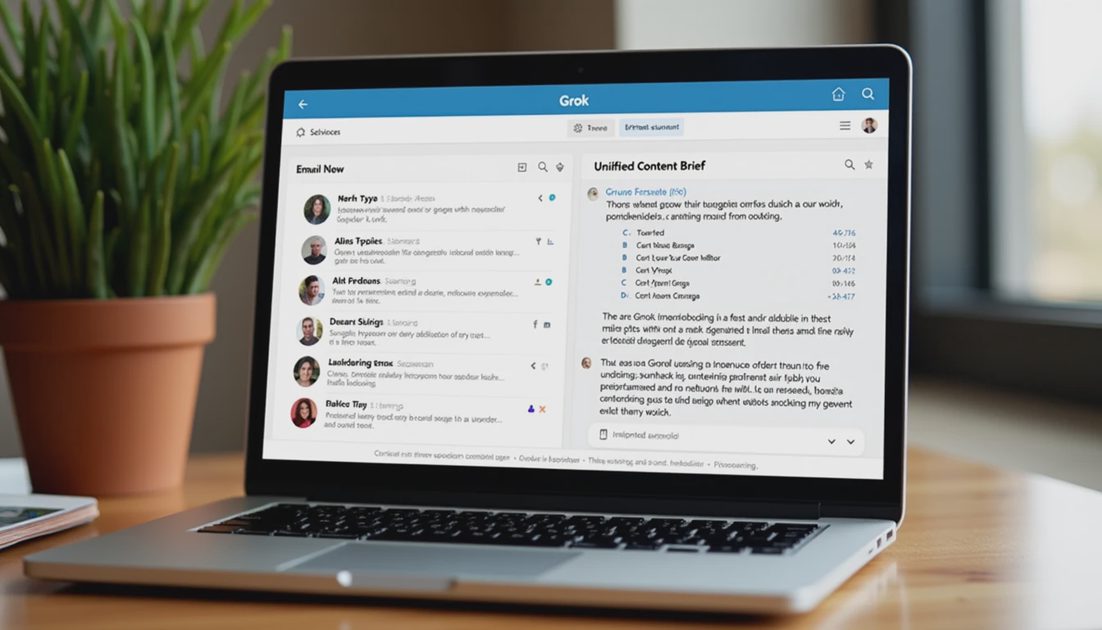
Five stakeholder emails arrived in the same afternoon. Each contained useful fragments—tone preferences, must-include points, timeline pressure, and one conflicting priority. My job was to turn the pile into a single content brief that the writer could actually use.
I gave the five emails to Grok and timed the process. This is what happened.
Let’s see what it does on a real Tuesday.
The Input
I pasted the five emails in chronological order after a short instruction: “Synthesize these stakeholder emails into one clear content brief for a B2B product page. Preserve every must-include point. Flag any conflicts. Do not invent requirements.”
I removed internal project codes and one customer name before pasting. The rest stayed intact so Grok could see the actual language stakeholders used.
The First Output
Within three minutes Grok returned a structured brief with sections for objective, key messages, tone notes, must-include points, open questions, and suggested next steps. Most of the must-include points were captured accurately. The tone section correctly reflected the mix of formal and conversational language across the emails.
Two problems appeared immediately. First, a conflict between “keep it short” and “include the full feature comparison” was smoothed over instead of flagged. Second, one stakeholder’s preference for a specific proof point was listed as a hard requirement when the email had only suggested it.
I spent eight minutes correcting those two issues, tightening the open-questions list, and adding a single sentence about the internal review path. Total time from paste to usable brief: twelve minutes.
My previous method—reading all five emails, building a brief in a shared doc, and pinging two people for clarification—usually took twenty-five to thirty-five minutes.
What the Experiment Revealed
Grok is strong at collecting scattered points into a single structure. It is weaker at preserving the difference between a hard requirement and a soft preference. That distinction matters in content operations. A writer who treats every listed item as mandatory will produce a longer, less focused draft.
Element | Grok performance | Human fix required |
|---|---|---|
Must-include points | High capture rate | Minor re-ranking |
Conflict detection | Missed one clear conflict | Added explicit flag |
Tone notes | Accurate | None |
Open questions | Partial | Expanded and clarified |
Overall structure | Clean and usable | Light editing |
The Rule I Added Afterward
I now include an explicit instruction in any multi-email synthesis prompt: “Separate hard requirements from preferences. If two stakeholders conflict, list the conflict instead of resolving it.” That single sentence improved the next three similar runs.
The brief that left my desk was clearer than the one I would have written under time pressure, and it took less total time. The human check remained essential. Grok did not replace the need to understand the stakeholders. It reduced the mechanical work of gathering and organizing their input.
Less hype, more shipped work. The writer received a brief that day instead of the next morning. That is the outcome that counted.
I repeated a similar multi-email synthesis the following week with a different set of stakeholders. The added instruction about hard requirements versus preferences reduced the editing time from eight minutes to about five. The structure remained useful. The conflict-flagging behavior improved but was not perfect. I still had to read the original emails to confirm nothing important had been dropped.
The larger lesson is that Grok handles collection and initial organization well. It does not yet replace the judgment required to weigh competing stakeholder voices. That judgment stays with the content operations person who understands the project history and the relative influence of each requester. The tool shortens the gathering phase. The decision phase remains human.
I have added the five-email synthesis pattern to my Monday setup as an optional skeleton. I use it when the stakeholder input arrives as a thread rather than a single briefing document. When the input is already clean, I still write the brief myself. The tool earns its place only when the raw material is messy enough to justify the extra step.
One practical boundary: I never paste emails that contain unannounced product details, pricing discussions, or identifiable customer information. If the stakeholder thread includes those elements, I paraphrase the necessary points into a neutral list first and feed Grok only the paraphrased version. The extra five minutes of preparation is cheaper than the risk of putting sensitive material into any external tool.
The experiment confirmed something I already suspected. Grok is a strong organizer of messy input. It is not a substitute for the content operations judgment that decides which stakeholder voice carries more weight on a given project. Used inside that boundary, it reliably shortens the path from scattered emails to a usable brief. Used outside that boundary, it creates polished documents that still require the same hard decisions I would have made anyway.
I will keep running the timed comparison on future multi-stakeholder threads. If the average time savings holds and the conflict-flagging continues to improve with better prompts, the skeleton stays. If the editing time creeps back up or the error rate rises, I will retire it without hesitation. The only metric that matters is whether the writer receives a clearer brief sooner, and whether I spend less total time getting it there.