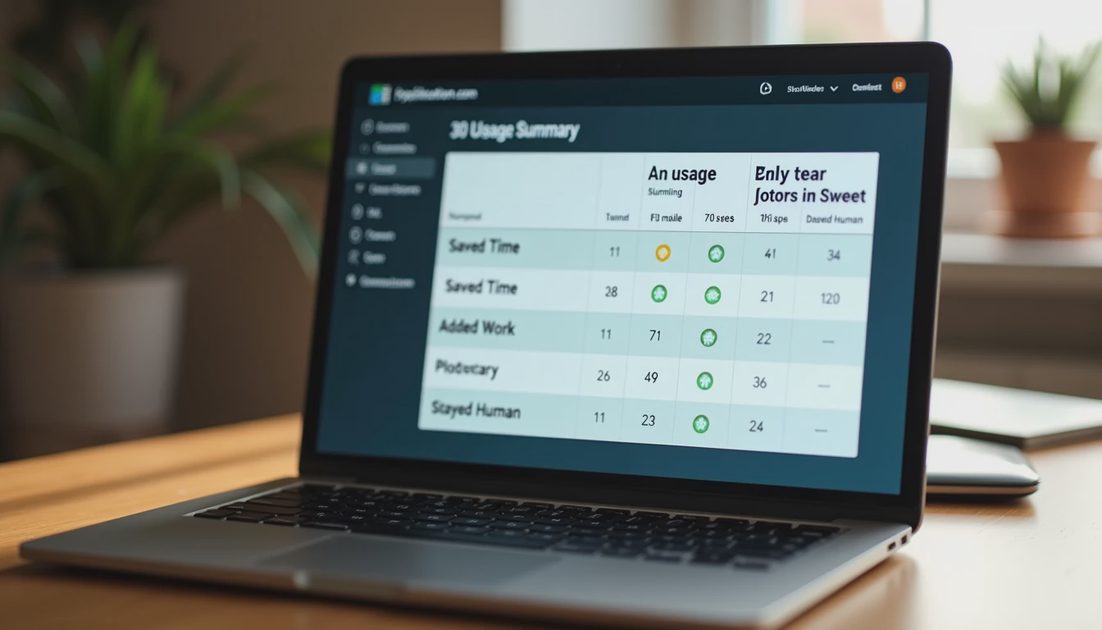
After thirty days of deliberate use across email, meetings, research, briefs, and follow-up, the results are mixed in a useful way. Some tasks got faster. Some created new checking work. A clear set of activities remained firmly human.
Let’s see what it does on a real Tuesday.
What Saved Time
Meeting-note extraction into action lists
First-pass research inventories from public sources
Structuring messy stakeholder input into brief outlines
Generating alternative phrasings for internal copy
These tasks showed consistent net savings when the input was reasonably clean and the output received a focused human review.
What Added Work
Status emails that required heavy context restoration
Research synthesis that needed extensive source re-checking
Copy rewrites that dropped important qualifiers
Any task where the cost of a small error was high
In these cases the first draft was fast, but the path to a reliable final version was not.
What Stayed Human
Activity | Why it stayed human |
|---|---|
Final ownership assignment | Requires knowledge of people and politics |
Tone decisions for sensitive stakeholders | Hard to specify fully in a prompt |
Accuracy sign-off on external claims | Responsibility cannot be delegated |
Priority calls under conflicting demands | Context sits outside the tool |
Deciding when to stop using a workflow | Judgment about net value |
Net Picture After Thirty Days
Clear time savings on structured extraction and first-pass organization
Neutral or negative results on high-context, high-risk communication
No reduction in the need for human verification on anything that leaves my desk
The tool earned a permanent place in some workflows and was deliberately excluded from others.
Rules That Survived the Month
Never paste sensitive client or internal details.
Always run a fact or source check on decision-facing output.
Treat every Grok draft as unfinished until a human has reviewed it.
Stop any workflow that increases total time or risk for two consecutive weeks.
Keep a short log of what worked and what did not.
Practical Judgment
Grok is a useful accelerator for specific, well-bounded tasks in content operations. It is not a general replacement for judgment, context, or accountability. The thirty-day test made the boundary clearer. That clarity is the main value I take forward.
Less hype, more shipped work. The work that ships still carries a human name. The tool helps with some of the steps that get it there.
Numbers Behind the Summary
Across the thirty days I logged roughly:
40+ meeting-note or action-list extractions
15 research or competitive inventories
25 brief or outline structuring tasks
30+ email or copy drafts of various types
The time savings clustered heavily in the first two categories. The added-work cases clustered in high-context email and external-facing copy. That distribution is now the basis for which tasks I default to Grok and which I keep fully manual.
What I Will Keep Doing
Using Grok for structured extraction and first-pass organization
Running source and fact checks on anything decision-facing
Maintaining the hard-no paste list
Stopping workflows that show negative net trends
What I Will Not Do
Treat Grok output as final
Use it as the default for sensitive stakeholder communication
Skip verification to save a few minutes
Assume a feature that worked once will keep working without re-checking
Closing View
Thirty days is long enough to see patterns and short enough to avoid over-fitting to a single busy period. The patterns are clear enough to guide the next quarter of use. Grok is a practical accelerator inside a defined perimeter. Outside that perimeter the work remains human. That boundary is the most useful result of the month.
How the Log Influenced Decisions
The short daily/weekly log turned out to be more valuable than I expected. Without it I would have remembered the successes more clearly than the slow increases in edit time. The log made the negative trends visible early enough to stop two workflows before they became habits.
I now treat the log as a permanent part of the Monday setup. It takes under five minutes a week and has already paid for itself in avoided rework.
Advice for Someone Starting a Similar Test
Pick a small set of recurring tasks rather than trying to use Grok for everything.
Record time and correction cost from the first week.
Decide in advance what “stop” looks like (for example, two weeks of negative net time).
Keep sensitive material out of the tool from day one.
Review the log at the thirty-day mark and write down the keep/drop rules while the experience is fresh.
Following those steps turns a vague experiment into a set of durable operating rules.
Final Position
Grok earned a lasting place in my content-operations toolkit for structured extraction, first-pass organization, and certain internal drafting tasks. It did not earn a place as a general replacement for judgment, context, or final accuracy. That outcome feels both unsurprising and useful. The next thirty days will be about applying the rules consistently rather than testing new categories.
Less hype, more shipped work. The month produced clearer boundaries. Clearer boundaries produce more reliable work.